
Women and carpentry: a workshop for aspiring builders
Jane Rose Speiser speiser@horseinthesky.it
Here we are, shipwrecked on the shores of the third millennium: Robinson Crusoes of our era, tossed about by the changeable winds of world economics, looking for a way to save our skins. It is not a specific profession or job title that is needed in these uncertain times, but an approach that encompasses the ability to observe, analyze and evaluate the problems that face us, and the equilibrium to execute tasks that are complex and may have to be modified in order to achieve the result one has envisaged.
These workshops, aimed toward acquiring skills in the building trades, (more specifically carpentry but also masonry and their various near and distant cousins) address all of those components of problem solving. They are not held with the illusion of turning you into a ‘mastercraftsperson’ in thirty thousand easy to follow steps, but rather to furnish you with a methodology that can be applied to many areas of your daily life.
What are the main steps taken in building a habitat, or a part thereof? First and very important one must imagine/create a mental image of the result. It is necessary to keep this vision firmly in mind as the path to its completion may take you on many detours. Then you must observe what tools and materials you have on hand, and how they will contribute to the final result. After that it is necessary to take very precise measurements in order to ensure that all of the pieces can be used in a suitable geometry for the task. At that point, you will need to dimension and shape the materials, by cutting, sawing, drilling, sanding and so forth, to fashion with precision all of the parts of the puzzle. And finally the parts are to be assembled into a functioning whole. Often, along the way, a more ingenious solution presents itself and you will benefit from the mental flexibility to improvise, on your way to the goal. In all of these steps there are tools to be used, pure manual dexterity to be acquired, the sense of balance of how your body and the materials intermesh with the space around you, and last but not least, the stubborn patience that is vital to dealing with the nature of the material world.
Why women? Because the above listed uses of the mind and body have long been associated with that other half of the inhabitants of the planet, to the point that we no longer have faith in our own innate abilities. The activities of the mind have been so compartmentalized that we have forgotten that the brain, (like angels) is unisex. And particularly in the Western world, where life is apparently less physically tiring, the use of the body has been devalued, as if it were merely a superfluous attribute of the mind. With the exception of the wrist, for moving the mouse, the rest of the body may be destined to become extinct like the prehensile tail. This workshop has the modest goal of helping us take back our minds and our bodies.
My own professional experience has fused a number of professions over the course of five decades of my adult life, which I believe has given me a rather unique perspective on how to wade through the post industrial swamp. I have taught people over the years in areas that range from laying tongue and groove flooring to using the software I designed for computer animation. I strongly believe that my skills can be transferred to anyone who desires to learn, and hope that you will find pleasure and benefit in participating in the workshop.
Women and Carpentry The organization of the course:
This workshop is addressed to anyone who wishes to learn more about the construction trades, in a practical as well as a theoretical sense. It does not presuppose that the person has had any previous experience in this area. The workshop is focused on an understanding of structure, for a wide range of carpentry work.
The workshop will last for four days. The subject matter covered during the workshop, will be equally divided between theory and hands on practice. The proposed schedule is as follows, but can be adapted to the interests of specific individuals.
Day 1: Arrival at Ponti di Pornassio, in the late morning; before lunch there will be a brief tour of the properties to become familiar with the spirit of the environment. Afternoon: the nature of wood, its varieties, resistance, aging, quality. The tools used for carpentry. The approach necessary to execute the work. There will be preliminary practice in using basic hand carpentry tools. I will describe the division of labor in the various phases of the work and the concept of structural strength. The participants will work in teams of two.
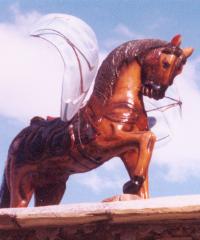
Day 2: will be devoted to the first two of the five phases of construction: defining and imagining the result; observing and organizing the materials with which to execute it. There will be further practice with electrical carpentry tools, sabre saw, drill, sanding disk and electric screw driver. This activity will be focused on a specific project to be carried out in the course of the workshop: either one of my signature Mondrian/Braque bookcases or a ‘rocking elephant’/variation of a rocking horse. The afternoon will include a discussion of triangulation for structural stability. Cocktail hour: an invited guest Alice Piscitelli will talk about her set construction workshop for theatre and films, in Genoa.
Day 3: will be dedicated to the second two phases: measuring and shaping the wood for the construction project, sawing sanding drilling. (n.b. accurate measuring is by far the more complex part of the two tasks. ) The afternoon’s theoretical topic will cover how to evaluate the use of wood in rebuilding an old country house. For the cocktail hour, an invited guest Margaux Hunter will speak about her experience of rebuilding a house in Lovegno.
Day 4: will be assigned to joining the materials to complete the project, to using the level, and understanding how to square up a structure. If there is time we will explore the different ways of treating wood: painting varnishing, staining. In the afternoon I will describe how wood is used to frame both a balloon frame new American house, a post and beam house and how these techniques have been imported to Europe.
our three houses